
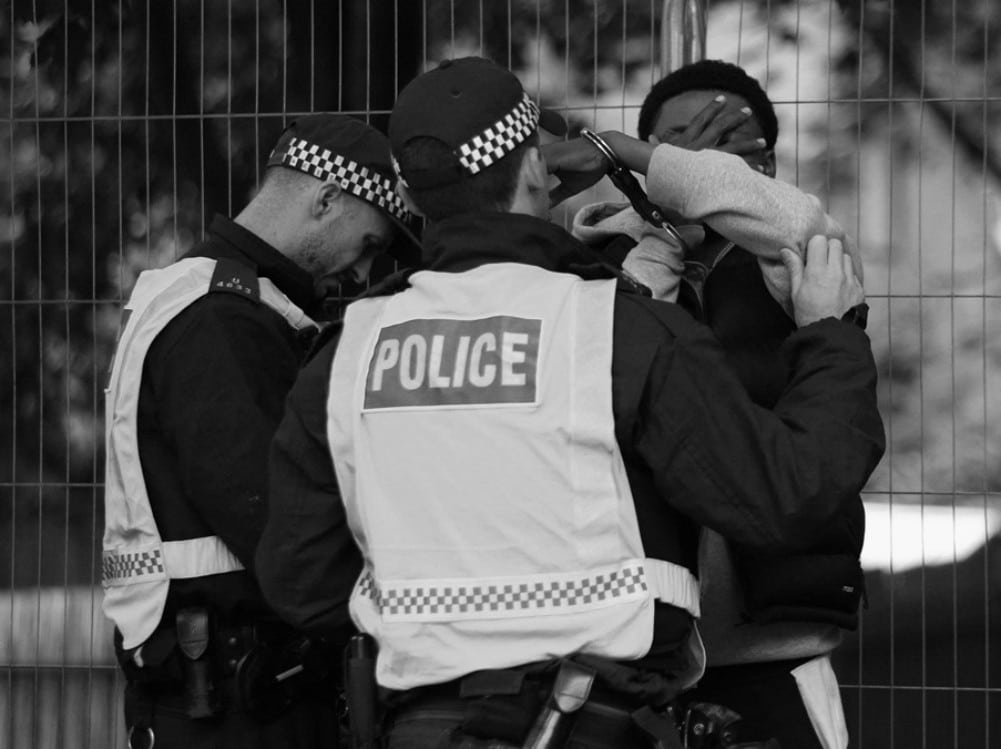
Metropolitan Police officers are four times more likely to use force against black people compared with the white population according to the BBC on July 30th 2020. The Met used force 159,000 times in 2019-20, with more than a third of cases involving black people. This article will explore what kind of pressures a black individual may encounter when coming into a confrontation with the law.
At the time of this statement from Youth Radio, Riley Lockett, identified as a black male, was16 years of age living in Oakland, California. He was walking to Bart Station from school when he was stopped by a police officer. He was stopped because he “matched the description” of someone that was accused of theft.
Most black teen’s natural vibe is very energetic, loud, flamboyant and full of character. This can be easily misinterpreted as aggression or maliciousness. Therefore Riley being able to walk freely, shows that he had to suppress that natural side of him to be more outwardly confident in the situation. He explains in this interview with Youth Radio that his mother, from a young age, would train him and his sister how to act if they were to ever have an encounter with a law enforcer. “Maintain eye contact… Stand straight… Speak when spoken to… No sudden movements”. Although it wasn’t a cop that had killed Trayvon Martin, this helped Riley comprehend what his mother was training him for. This shows that a change shouldn’t just be made in the police department or officials but it should be reinforced across all professional environments and societies. “We are in a city where a police officer is usually seen as more of a threat than a friend. As a young black man, I know an officer of the law can shoot me no matter where I am”. These poignant words from Riley may help people from a non-black background to understand that it is an essential need for black children to be trained how to and how not to act in the eyes of a law enforcer by their parents. Unfortunately, if there is a lack of this training, the likelihood of an altercation similar to Riley’s may end in tragedy. For example, George Floyd was murdered by Derek Chauvin by kneeling on his neck for seven minutes and 46 seconds, resulting in a death. (New York Times, 2017). I use the word “training” because as a parent, by delivering this training, you are essentially teaching your child mandatory survival skills they will need to not be hindered by the law enforcement.
Some people may not think this is not relevant to the UK, however there are multiple examples of how police brutality has changed the lives of many black people in the UK.
Although guns are not legal in the UK, this may still scare parents into training their children on how not to seem a threat or intimidating in the eyes of police.
In the police call to the police that lead to George Floyd’s murder, an employee from Cup Foods describes George’s actions to be “drunk” and “not in control of himself. If Riley Lockett, during his conversation, portrayed similar behaviors to Gearge Floyd at the time of his death, then this confrontation may have ended very differently.
This portrays how easy it is to seem dangerous or to be seen as a threat to police. Was George Floyd killed because he didn’t “Maintain eye contact… Stand straight… Speak when spoken to… No sudden movements”? I don’t think so. Some police officers before an encounter, clearly already have an agenda. This is the worrying factor. If he was to adhere to society, would this have happened? Unfortunately, no matter how calm you are or how innocent you may be, it might not be enough to save you from racism. (BBC, 2020)
Police in the UK are licensed to carry firearms such as tasers. A taser is an electrical control device that is often used by law enforcement to subdue suspects they believe are resistant, without physical contact. In the UK they are classed as firearms due to their ability to harm or incapacitate. Stun guns are classed as firearms under UK law. A taser can be used from a distance (in some cases up to 30 feet). It typically shoots out two probes which penetrate the target and deliver the required electric shock. A taser delivers 19 short pulses per second over 5 seconds, with an average current of 2 milliamps, according to TASER manufacturer Axon. (Wheldon Law, 2017)
Developers of this weapon find it difficult to measure the effects that a taser may have on the human body. This is because the people most likely to be tasered are people who are sick, stressed, drunk, high on drugs, experiencing a psychotic episode or emotional crisis or strenuous exertion. They may also be likely to experience exacerbated health complications. Therefore, it’s impossible to ethically test for them.
Weapon experts say, if you’re perfectly healthy and sober, being tasered will hurt a lot for approximately five seconds. Otherwise, you will be left unscathed. However, if you aren’t healthy, or sober, the effects are unknown. Tasers are capable of an output of 50,000 Volts, but the voltage delivered to the body is only 1,200 Volts. The initial high voltage is used to establish a current between the two taser barbs. (Rodger, 2017)
When used properly a taser does not cause major health risks. However, they present more dangers for people with medical conditions, especially heart issues. If a current as small as 0.0002 Volts was to directly strike a human heart, it causes a fatal rhythm called Ventricular Fibrillation. Considering the initial voltage that is projected into the body from a taser shot is 1,200 Volts, this statistic is actually terrifying. (Patel, 2018)
Due to this, the simple encounter of being in a confrontation with two police officers with their hands on tasers may cause a young person to act differently. The effects that someone may experience are increased levels of confusion, sudden loss or condensed speech, rapid perspiration, an increased heart rate and they may even start to look over their shoulders. The British Heart Foundation (BHF) states that “If you’re African or African Caribbean in the UK you’re at higher risk of developing high blood pressure and having a stroke than other ethnic groups. You also have a greater chance of developing Type 2 diabetes, which can increase your risk of heart attack and stroke.” (BHF, 2020). Taking this into consideration, it can seem very difficult to “Maintain eye contact… Stand straight… Speak when spoken to… No sudden movements.” because in order to do so, you have to do the exact opposite of what human instinct is, which is to escape danger in order to survive. When a person is afraid, the Amygdala sets off a chain reaction in your brain. The Amygdala is responsible for the instinct to fight or flee. When the Amygdala identifies that it’s body is in danger, it sends a distress message to the Hypothalamus. The Hypothalamus activates the sympathetic nervous system, which triggers the emotion fear. When survival is at stake, the body reacts without thinking. The brain either tells the individual to stay on the path and fight through a predicament, or give up completely. (Ho, 2020)
This squelching towards black people can have negative psychological effects such as self hatred, low self-esteem and belittless. From personal experiences, I know that it is very easy for a black person’s mental health to deplete due to our physical appearance. When I am walking the streets of Birmingham or even in my own work place I am very conscious of the way I appear to others. Similarly to university student Ben Arthur who said “With the whole Trayvon Martin with the hood thing, when I walk around at night I kind of have to be conscious of that, about how I appear… Because being black and walking around late at night with a hood on, I’m seen as suspicious… just because I’m black… not because I was actually doing anything wrong. It really belittles us – having such a vague description.” (The Beacon, 2015). Killing the problem before the problem is apparent, is better than finding a solution once the problem has revealed itself. Black people are aware of how they look in society which adds to the psychological distress of themselves. Which can grow into a fear of being seen as something that they are not. This may lead to a change in behaviors, such as the ones I have previously discussed. If the individual is identified as something that they are not, this can evolve into a fear for their life.
Most parents would want to train their children to adhere to the rules of society and to show attributes that civilisation wants. Not only do black parents have to teach their children to be modern criticism, but also how not to appear to be the opposite.
The agenda is that the police are already against black people and even if a teen was to “Maintain eye contact… Stand straight… Speak when spoken to… No sudden movements” may not be enough and that is scarily concerning. Parents shouldn’t have to train their children to “Maintain eye contact… Stand straight… Speak when spoken to… No sudden movements” to increase the chances of them coming home safely that day. In order to build a safer foundation for the next generations we need to change the direction of diversity. By teaching anti-racist practices we can EmbRACE all diversities for a fearless future for all.
Recent Comments